[Cliquez ici pour la version française]
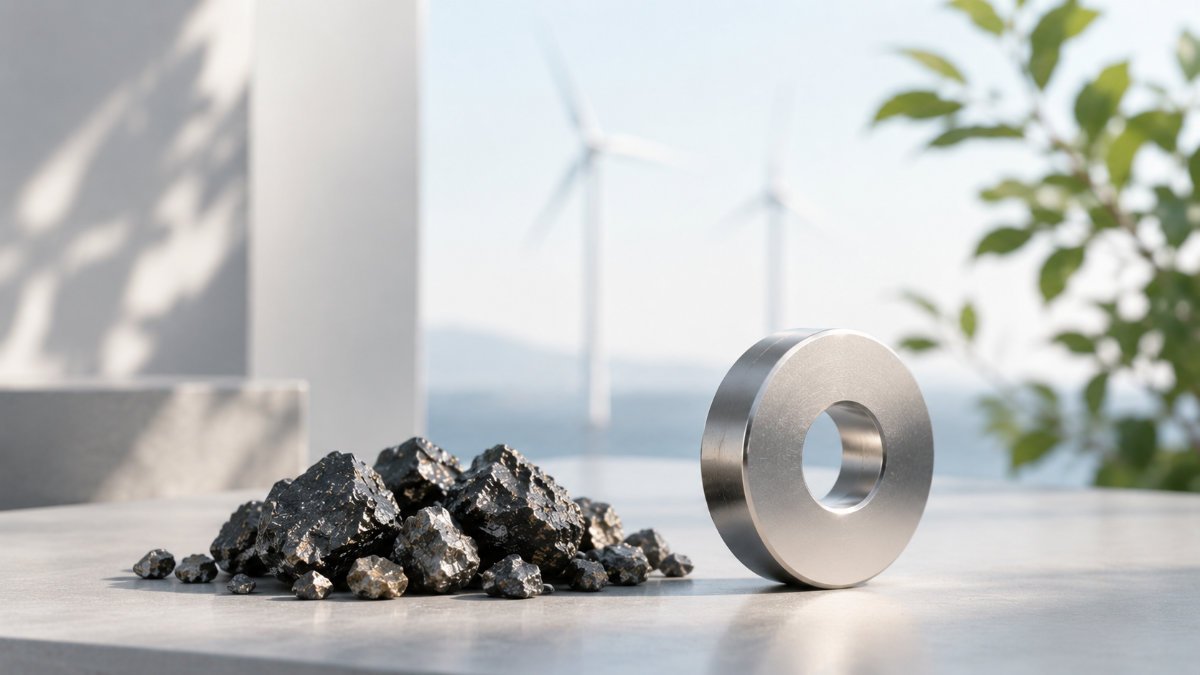
A topic that worries people more than it should
Rare earths are everywhere in modern industry: electronics, automotive, wind power, sensors, aeronautics. Yet their name often suggests extreme scarcity or an imminent risk, when the reality is more nuanced. Understanding what they are and why they have become strategic makes it possible to approach the subject with greater perspective.
What is a rare earth, exactly?
Seventeen metals, not exotic materials
Rare earths refer to a group of seventeen metals, including neodymium, samarium, dysprosium, and terbium. Contrary to what their name suggests, they are not geologically rare: extraction is common, but chemical separation is complex and costly to deploy at scale.
A main use: permanent magnets
Their best-known use remains the manufacture of permanent magnets. Neodymium is used for its strong magnetic force, samarium for its high-temperature stability, while so-called “heavy” rare earths such as terbium or dysprosium allow certain magnets to retain their performance at very high temperatures.
Why this topic has become strategic
Highly concentrated production geographically
According to 2025 data from the US Geological Survey, China accounted for about 69% of global rare earth mining production (Rare Earths Mining Industry Review, 2026). Its position is even more dominant in processing: the country handles around 90% of rare earths worldwide (Mining Technology, 2026), and its share of global production of rare earth permanent magnets is estimated between 85% and 90% (Rare Earth Exchanges, 2025).
An evolving regulatory framework
Since April 2025, export licenses issued by China’s Ministry of Commerce (MOFCOM) have regulated the export of certain rare earths from Chinese territory, including samarium, gadolinium, terbium, and dysprosium. This regulatory framework changes lead times and supply conditions, without calling into question the overall availability of these materials on the global market.
What Europe is doing about this dependence
The Critical Raw Materials Act
The European Union has adopted the Critical Raw Materials Act (CRMA) to reduce its dependence on critical raw materials, including rare earths. Its 2030 targets are clear: cover 10% of European needs through local extraction, 40% through processing, 25% through recycling, and avoid relying on a single country for more than 65% of each strategic material (Digital Wallonia, 2025).
A long-term trajectory, not an immediate solution
These targets reflect a strong political will, but their implementation remains gradual. For companies, this means continuing to organize now, without waiting for a full market shift in the short term.
Do you have a supply constraint to anticipate?
Let’s talk about your project: a technical sales expert can help you choose the most suitable and most available material for your application.
Recycling, a complementary solution available today
Still largely untapped potential
Rare earth recycling is progressing worldwide, but remains limited today: less than 1% of rare earths present in electronic or industrial waste are currently recycled (ADEME, 2026). This room for growth represents a real opportunity to secure future supply, as a complement to conventional extraction.
Calamit’s offer: recycled neodymium magnets
Calamit offers neodymium magnets made from recycled material, produced in China. This offer provides access to a high-performance and available alternative, without relying exclusively on virgin raw material. To learn more about the principle of neodymium magnet recycling, a dedicated page explains how this supply chain works.
What this means for businesses like yours
Vigilance has become a useful skill
Keeping track of strategic raw materials is no longer reserved for large groups. It has become a useful skill for anticipating lead times, comparing available options, and securing technical choices, especially across neodymium, samarium-cobalt, or Alnico grades depending on the intended application.
Choosing based on performance and availability
The right reflex is to compare solutions based on performance, availability, and cost, rather than on an idealized geographic origin. A recycled magnet can therefore be a relevant alternative when its technical characteristics meet the need, without complicating the supply chain.
What to remember
Rare earths remain a closely watched topic, shaped by a globally concentrated production base of around 69% in China for extraction and up to 90% for processing, within a Chinese regulatory framework that has evolved since April 2025. But concrete solutions are already available on the market to secure supply: gradual diversification at the European level, and above all recycling, with an immediately available offer from Calamit. This is not a crisis to endure, but a market evolution that can be adapted to now.
Looking for a reliable alternative?
Calamit offers neodymium magnets made from recycled material, just as high-performing as conventional magnets, to secure your supply.